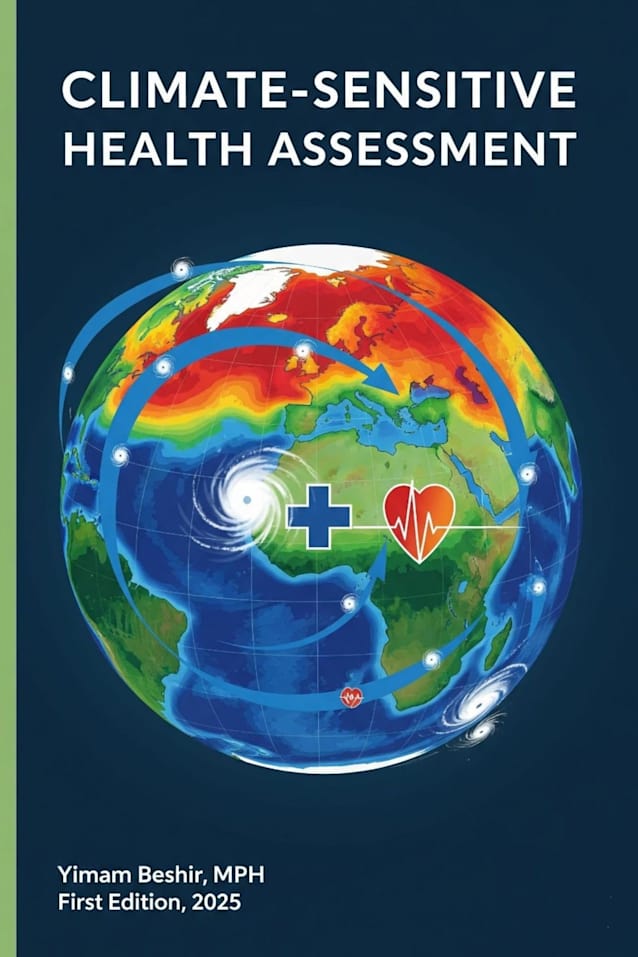
Climate-Sensitive Health Assessment : Methods for Evaluating Environmental Stressors (Environmental Impact Assessment Series: Integrated Tools for Climate–Health Decision-Making)
About
Climate change is the defining public health emergency of the 21st century—and yet, most traditional Health Risk Assessments and Environmental Impact Assessments (EIAs) still overlook climate-driven stressors as fundamental determinants of disease burden.
Authored by Yimam Beshir, MPH, Climate-Sensitive Health Assessment is a rigorous, method-focused guide designed for public health practitioners, climate adaptation planners, EIA consultants, and researchers seeking a systematic, evidence-based framework for evaluating climate-related health risks.
Moving beyond static assessments, this book provides step-by-step guidance for applying modern analytical tools and translating scientific insights into actionable adaptation strategies. Readers will learn how to:
• Operationalize Climate Risk
Implement the IPCC risk model (Hazard × Exposure × Vulnerability) using advanced techniques ranging from high-resolution climate datasets to equity-weighted vulnerability indices.
• Evaluate Major Climatic Stressors
Assess health risks associated with extreme heat, vector-borne diseases, declining air quality (including wildfire smoke), water insecurity, and compound climate events.
• Apply Quantitative Modeling Tools
Use cutting-edge approaches such as Distributed Lag Non-linear Models (DLNMs), climate projection datasets (CMIP6, RCPs, SSPs), machine learning algorithms, and early-warning system analytics to produce robust, reproducible evidence.
• Strengthen Adaptation and Planning
Integrate scientific findings into Health National Adaptation Plans (H-NAPs), design effective interventions, and develop monitoring and evaluation systems that prevent maladaptation and strengthen long-term community resilience.
Grounded in real-world challenges, this guide centers the needs of frontline health workers and communities in low- and middle-income countries, where climate impacts are most acute and data constraints are common. Its methodologies are scalable, context-specific, and built to function even in resource-limited environments.
Essential for practitioners, policymakers, and researchers, Climate-Sensitive Health Assessment translates complex climate–health interactions into coordinated, multi-sectoral strategies that support stronger, healthier, and more climate-resilient communities.